WELCOME!!

Hello from The 4 Brothers Ranch! Our family has a lot going on and a couple blogs in order to keep things organized. You can find all our homeschooling stuff here! Annissa's regular everyday blog is called A PAGE IN MY BOOK and also there is a blog to update the kids medical issues at MY UNIQUE FLOWERS. Please check those out too!
Showing posts with label History. Show all posts

Tuesday, May 14, 2013

Old American Slang & Traditions Explained!

One of my girlfriends shared this on Facebook tonight and I had to share it :)


A HISTORY LESSON, VERY INTERESTING

They used to use urine to tan animal skins, so families used to all pee in a pot and then once a day it was taken and sold to the tannery.......if you had to do this to survive you were "Piss Poor"

But worse than that were the really poor folk who couldn't even afford to buy a pot......they "didn't have a pot to pee in" and were the lowest of the low.

The next time you are washing your hands and complain because the water temperature isn't just how you like it, think about how things used to be. Here are some facts about the 1500s:

Most people got married in June because they took their yearly bath in May, and they still smelled pretty good by June.. However, since they were starting to smell . ...... Brides carried a bouquet of flowers to hide the body odor. Hence the custom today of carrying a bouquet when getting married.

Baths consisted of a big tub filled with hot water. The man of the house had the privilege of the nice clean water, then all the other sons and men, then the women and finally the children. Last of all the babies. By then the water was so dirty you could actually lose someone in it.. Hence the saying, "Don't throw the baby out with the bath water!"

Houses had thatched roofs-thick straw-piled high, with no wood underneath. It was the only place for animals to get warm, so all the cats and other small animals (mice, bugs) lived in the roof. When it rained it became slippery and sometimes the animals would slip and fall off the roof...Hence the saying "It's raining cats and dogs."

There was nothing to stop things from falling into the house. This posed a real problem in the bedroom where bugs and other droppings could mess up your nice clean bed. Hence, a bed with big posts and a sheet hung over the top afforded some protection. That's how canopy beds came into existence.

The floor was dirt. Only the wealthy had something other than dirt. Hence the saying, "dirt poor." The wealthy had slate floors that would get slippery in the winter when wet, so they spread thresh (straw) on floor to help keep their footing. As the winter wore on, they added more thresh until, when you opened the door, it would all start slipping outside. A piece of wood was placed in the entrance-way. Hence: a Threshold.

In those old days, they cooked in the kitchen with a big kettle that always hung over the fire.. Every day they lit the fire and added things to the pot. They ate mostly vegetables and did not get much meat. They would eat the stew for dinner, leaving leftovers in the pot to get cold overnight and then start over the next day. Sometimes stew had food in it that had been there for quite a while. Hence the rhyme: "Peas porridge hot, peas porridge cold, peas porridge in the pot nine days old." Sometimes they could obtain pork, which made them feel quite special. When visitors came over, they would hang up their bacon to show off. It was a sign of wealth that a man could, "bring home the bacon." They would cut off a little to share with guests and would all sit around and "chew the fat".

Those with money had plates made of pewter. Food with high acid content caused some of the lead to leach onto the food, causing lead poisoning death. This happened most often with tomatoes, so for the next 400 years or so, tomatoes were considered poisonous.

Bread was divided according to status. Workers got the burnt bottom of the loaf, the family got the middle, and guests got the top, or the "upper crust".

Lead cups were used to drink ale or whisky. The combination would Sometimes knock the imbibers out for a couple of days. Someone walking along the road would take them for dead and prepare them for burial.. They were laid out on the kitchen table for a couple of days and the family would gather around and eat and drink and wait and see if they would wake up. Hence the custom of holding a "wake".

England is old and small and the local folks started running out of places to bury people. So they would dig up coffins and would take the bones to a bone-house, and reuse the grave. When reopening these coffins, 1 out of 25 coffins were found to have scratch marks on the inside and they realized they had been burying people alive... So they would tie a string on the wrist of the corpse, lead it through the coffin and up through the ground and tie it to a bell. Someone would have to sit out in the graveyard all night (the graveyard shift.) to listen for the bell; thus, someone could be, saved by the bell or was considered a "dead ringer".

And that's the truth....Now, whoever said History was boring

Sunday, May 12, 2013

Teaching State History


Teaching State History: An Outline With Projects

Rusty and Sandy Sieber, PAHistoryBooks.com


Editor's Note: This article originally appeared in the Fall 2011 issue of The Old Schoolhouse® Magazine, the trade magazine for homeschool families. Read the magazine free at www.TOSMagazine.com or read it on the go and download the free apps at www.TOSApps.com to read the magazine on your Kindle Fire or Apple or Android devices.

German spies infiltrated the Pennsylvania Railroad during World War II. A Pinkerton detective went undercover as a coal miner to investigate the Molly Maguires in the coal regions of Pennsylvania. Frank Piasecki, who invented the dual-rotor helicopter, first built a helicopter in his garage in Philadelphia and tested it by flying around the surrounding countryside. These are just some of the interesting facts my family uncovered as we explored Pennsylvania state history.

Following are some of the ideas and activities that have emerged out of those years. Although originally designed to teach Pennsylvania history, this plan can be used to study the history of any of the fifty states.
Most children in fourth through eighth grade will be able to read and complete the activities independently. Special needs children and younger children will need more help, including some adjustments to the activities. Older children can use the outline and question prompts to write a research paper or devise their own projects.

Gather together any books about your state that you may already have. Next, go to your public library and see what is available. What you don’t find anywhere else can usually be found on the Internet. A list of some sites that we found helpful is offered in the sidebar.

Introduction
Activity: Make a “learning web” to show what you, the student, already know about your state. (See sidebar.) Save your web so you can add to it when you have completed this state history study.

Origin of the State

1. Thirteen Colonies
Activity: Find a map of the original thirteen colonies of the United States by looking in a U.S. history book or online. Was your state one of them? If so, draw a map of the original thirteen colonies and label your state.

2. Other
Activity: If your state wasn’t one of the original thirteen colonies, how and when did it become a state? Learn about your state by reading a book about it, or read about it online. Write a newspaper article announcing your state’s entry into the Union. Include the date and circumstances.

Symbols

1. State symbols
Activity: Each state legislature has chosen a certain bird, mammal, tree, flower, etc. to represent its state. These can be found online at www.netstate.com. Make a set of flashcards with the general category on one side and specific object on the other. Use the flashcards to learn the state symbols.

2. Coat of Arms
Activity: Find a picture of your state’s coat of arms, draw it, and make a list of the objects included on it. Try to find out the meanings of those objects and why they’re included.

3. Nickname
Activity: Find out the nickname of your state. Why does your state have its particular nickname? Make a banner with your state’s nickname on it.

4. Slogans
Activity: Most states also have a tourist slogan. Investigate how that slogan was chosen. Create your own slogan for your state and be able to explain why you chose it.

Native Americans

1. Tribes
Activity: Find the names of the tribes who lived in your state. Make a booklet about one of the tribes. Label and draw pictures to illustrate a page for each of these topics: food, dress, home, and language.

2. Locations
Activity: Find out specifically where each tribe lived. Draw a simple map of your state. Color the map and label the locations.

Early Settlers

1. European Immigrants
Activity: Find out what brought immigrants to your state. In a book about your state, check the index for names of specific nationalities. Make a chart with the nationalities and the reasons they left their homes to come to your state. An interesting site online is The New York Times Immigration Explorer. You can click on a nationality and move a slide to show its population in your state through the years.

2. Movement From Other States
Activity: Check to see if groups of people moved from another state to your state and find out why. Make another chart that illustrates this information.

3. Personal Family History
Activity: Draw a family tree and include the locations where your ancestors were born. Ask your grandparents and/or use one of the online genealogy sites.

Industry

1. Past Industries
Activity: Make a timeline to show which industries operated at different times in your state’s history. One way to divide the timeline is according to the beginning dates of wars. War usually changed a state’s industries, especially the Revolutionary War (1775–1783), the Civil War (1861–1865), World War I (1914–1918), and World War II (1939–1945).

2. Specific Industry
Activity: Pick one of the early industries of your state. Learn more about it. Read a description of one of the processes involved in that industry. For example, the iron industry needed charcoal. If the production of iron was an early industry in your state, read about how the charcoal was produced. Another industry was lumbering. How did the logs reach the cities? Draw a cartoon-type illustration to show one of the processes involved in the industry that you chose.

3. Great Inventors
Activity: Find out if any great inventors lived in your state. Look in your reference books or do an online search for “great inventors from (your state’s name).” Draw a picture of some of their inventions, or take photos of modern tools that have been developed as a result of their inventions. Label each with the inventor’s name.

Major Events

1. Catastrophic Events
Activity: Read first-person accounts of catastrophic events in your state. Fill in a chart for each event to answer who, what, when, where, and how.

2. Other Events
Activity: Each state has a unique history. What unique events took place in your state? If possible, conduct an interview with someone who knows about it. First, make a list of questions to ask. Then, as you interview, take notes or video record. If you have no living resource person, read a firsthand written account from that period and make up a pretend interview with answers that use real facts.

Natural Resources

1. State or National Parks
Activity: Investigate how the state and national parks in your state came to be and how they got their names. Use a website that gives information about the parks. Look for the historical information section.  Design a game based on the information that you find. Write clues about each park and make a path with them on the game board. Prepare and keep nearby a master sheet that lists the answers. Invite a friend or family member to play. Use a die to move. Whoever can identify the park gets to move extra spaces. First one to the end wins!

2. Historic Waterways
Activity: Look for the major rivers in your state and discover which towns or cities are located near them. Look at the history of one of those towns and find out what part the waterway played in the settlement of the area. Many towns have websites that feature accessible historical documents.

Cities

1. Major Cities
Activity: Identify the largest cities by reviewing a population chart. Locate those cities on a map of your state.

2. In-Depth Study
Activity: Investigate a different city from the one you picked during the waterways lesson. Find out when it was founded and why. Research what its major industries used to be. What different groups of people settled in that city? What historical sites are there? Design a poster telling about the history of that city.

Government

1. Capital
Activity: Visit your state’s Capitol building in person or online.

2. Organization
Activity: Find out how your state government is organized politically. Write to one of your state representatives or senators and request information about your state government.

Historical Places and Tourist Sites

1. Tourism
Activity: Visit an online tourist site, or pick up pamphlets about your state’s main attractions in a Welcome Center. Make your own travel brochure, highlighting the most interesting places with hand-drawn pictures and short descriptions.

2. Locations
Activity: Using a road map, circle the locations of the tourist sites that you chose.

Transportation

1. Land Travel
Activity: What were some of the early forms of transportation in your state? Using cereal box cardboard, make a 3-D model of one of them.

2. Water Travel
Activity: What kinds of boats were first used in your state? Look for an interesting story involving water travel. Make up a skit about it.

War Involvement

1. State’s Role
Activity: What battles were fought in your state? What part did your state play in each of the early wars? Look for names of organizations that ministered to victims. Make a timeline listing the information that you found, and include these wars: Revolutionary War (1775–1783), French and Indian War (1756–1763), Civil War (1861–1865), War of 1812 (1812–1815), and the Spanish-American War (1898).

2. Specific People
Activity: Make a list of commanding officers and heroes from your state. Include the hometowns of those war veterans. One place to look is www.homeofheroes.com.

Famous People

1. Presidents
Activity: Were any U.S. Presidents born in your state or did any of them live there at any time? Have their birthplaces or residences become historical sites? Visit them or learn about them online.

2. Industry
Activity: Were any famous industrialists from your state? What industries were they involved in? Some books written about your state will offer this information, or you can type in a search on the Internet for “famous industrialists from (your state’s name).” Create line drawings to represent the industries. Use your line drawings to illustrate the lists of men that you found who are famous for developing that industry. You can post your drawings above the lists, use the drawings to encircle the lists, or use the names of the industrialists as the lines in your designs.

3. Writers, Actors, Musicians, Artists, and Other Famous People
Activity: Make a chart with spaces to list five or six people’s names. Include these headings: name, birthplace, years lived in your state, other places lived, why they’re famous, good character qualities, and favorite facts. Again, some books can provide a list to choose from, or you can do a search on the Internet for “famous people from (your state’s name).”

Conclusion
Activity 1: Remember the web you drew at the beginning of this study? Now add all the things that you have learned.
Activity 2: Pick a person you have learned about during your study of state history and write a monologue for him. Find pictures of clothing from your subject’s time period. In a used clothing store, look for and buy items of clothing that are similar. Dress in these and present your monologue for your friends, relatives, or homeschool support group.

Helpful Websites
www.ancestry.com—genealogy
www.congress.org—state and national government officials
www.50states.com—state nicknames, biographies, admission to statehood
www.homeofheroes.com—military award citations
www.netstate.com—state symbols, seals, maps, flags, history, government, economy, people
The New York  Times Immigration Explorer
www.onegreatfamily.com—genealogy
www.statesymbolsusa.org—state symbols

How to Make a Learning Web
1. Use two pieces of butcher paper taped side by side to create a large area to write on.
2. Write your state’s name in the center
3. Draw webs coming from the center.
4.  Add a subtopic to the end of each web.
5. Continue to add webs to expound the information.

State Science
1. Trees
Activity: Find a book or a website about trees that can be found in your state. Use it to identify the local trees in your neighborhood or park. Learn about products that come from each tree and the history of the tree. Was it originally brought from another country or another state? Make a chart with these headings: common name, scientific name, average height, location in state, products, and history.
2. Flowers
Activity: Make colored drawings of flowers found in your state, or find a list of your state’s flowers and write down which ones you’ve seen. If possible, find out which are indigenous to your state.
3. Animals
Activity: First, make a list of animals common to your state. Then, do a more in-depth study of one of them and write a report about that animal. Include whether that animal always lived in your state or where it originally came from, if possible.

Rusty and Sandy Sieber live near Thompsontown, Pennsylvania, and have always homeschooled their four children. Suzanne and Tad have graduated. Matt will finish this year, but Ben will be their student for a few more years. Sandy holds a M.Ed. and works part-time as a substitute teacher. She has written workbooks for students to use when studying Pennsylvania history. Her website is www.pahistorybooks.com.  
Publication date: October 12, 2012

Page Source (url): http://www.crosswalk.com/family/homeschool/resources/teaching-state-history-an-outline-with-projects.html

Friday, November 2, 2012

Local Area: Port Gamble Museum

This post has taken me FOREVER to finish!  LOL ....   but I finally have :)

Check out our previous entries: PORT GAMBLE HISTORY and HISTORIC PORT GAMBLE featuring our walk through the town and the history posted around town.

The Port Gamble Museum is located down the hill in the basement area of the General Store & Cafe. It was extremely interesting for me because in my hometown (Eau Claire, WI) ... there is a Pope & Talbot (or at least that's what it was when I was growing up, it's still there - but it was bought out.) ...  anyway - so I had no idea that Pope & Talbot had originated here. It was interesting to me ...

 LARGE ANCHOR .. this anchor came from the sunken lumber schooner "War Hawk".  It was found 200 feet from the hull in Discovery Bay.


 GRINDSTONE - This grindstone was used in the mill until 1895 when it was given to Knute O. Vaa by Cyrus Walker when Knute retired.  It was then donated by Edwin Vaa at the time of his fathers death.
 WORTHINGTON DEPLEX PUMP - Steam driven water pump used in Port Gamble Sawmill from 1913 to 1974.  It supplies high pressure water to all the plant and townsite fire hydrants.
 Inside the Museum.

 SPRINGBOARD - Often, trees of the West were so large at their base that in order to fell them, a springboard was necessary to elevate a logger to a higher and narrower portion of the tree trunk.  The springboard was wedged into a notch chopped into the trunk of the tree and was supported by a metal lip, which anchored it firmly into the upper wood of the notch.

 
CLIMBING IRONS - These sturdy irons fit under the foot of the logger and were strapped to the leg at the ankle and below the knee.  Equipped with sharp spurs, the climbing iron aided the logger in climbing a tree. 

Captain's Cabin

CAPTAIN'S CABIN ABOARD THE ORIENTAL - This cabin was home to Captain Talbot on his long voyage to Puget Sound, and was relatively comfortable in heavy seas.  Men tended to be somewhat shorter 125 years ago, thus the lack of head room in the cabin. 

Like most mariners of the period, the captain's cabin contained an unusual array of tools, bedding, clothing, utensils, and furniture.  Greatly important was the ship's sextant for determining direction by shooting the sun and stars, as was the teltale compass positioned above the Captain's bunk. 

 CAPTAIN WILLIAM C. TALBOT * 1816-1881 * Captain William C. Talbot became a principal partner in the new enterprise and his extensive seafaring experience contributed much to the Company's successful growth.  

It was Captain Talbot along with Cyrus Walker, another down-Easterner, who built the first sawmill at Port Gamble in 1853.


 CARGO HOLD OF THE ORIENTAL - In this small ship Captain Talbot carried enough lumber to construct temporary facilities for his men while they built the new sawmill at Port Gamble. 

In addition, the ORIENTAL carried tools, foodstuffs, and items suitable for trading with the local Indians. 

The large basket was the principal means of transporting cargo from the ship's hold to shore. 


 HOWITZER BALL - U.S. STEAMER MASSACHUSETTS - This iron Howitzer ball has been traced back to the historic time when America suffered its first naval casualty in the Pacific.  

Gustave Englebrecht, coxswain aboard the U.S. Steamer Massachusetts, was fatally wounded by a northern Indian iron slug during a major Indian uprising on November 21, 2856.  His grave is located in the Port Gamble cemetery.  

The howitzer ball was given to Henry Cotter, a mill tallyman by an Indian from the Little Boston community in 1910.  The Indian was chopping firewood from a cedar log when the ball rolled out of a split piece of wood. 

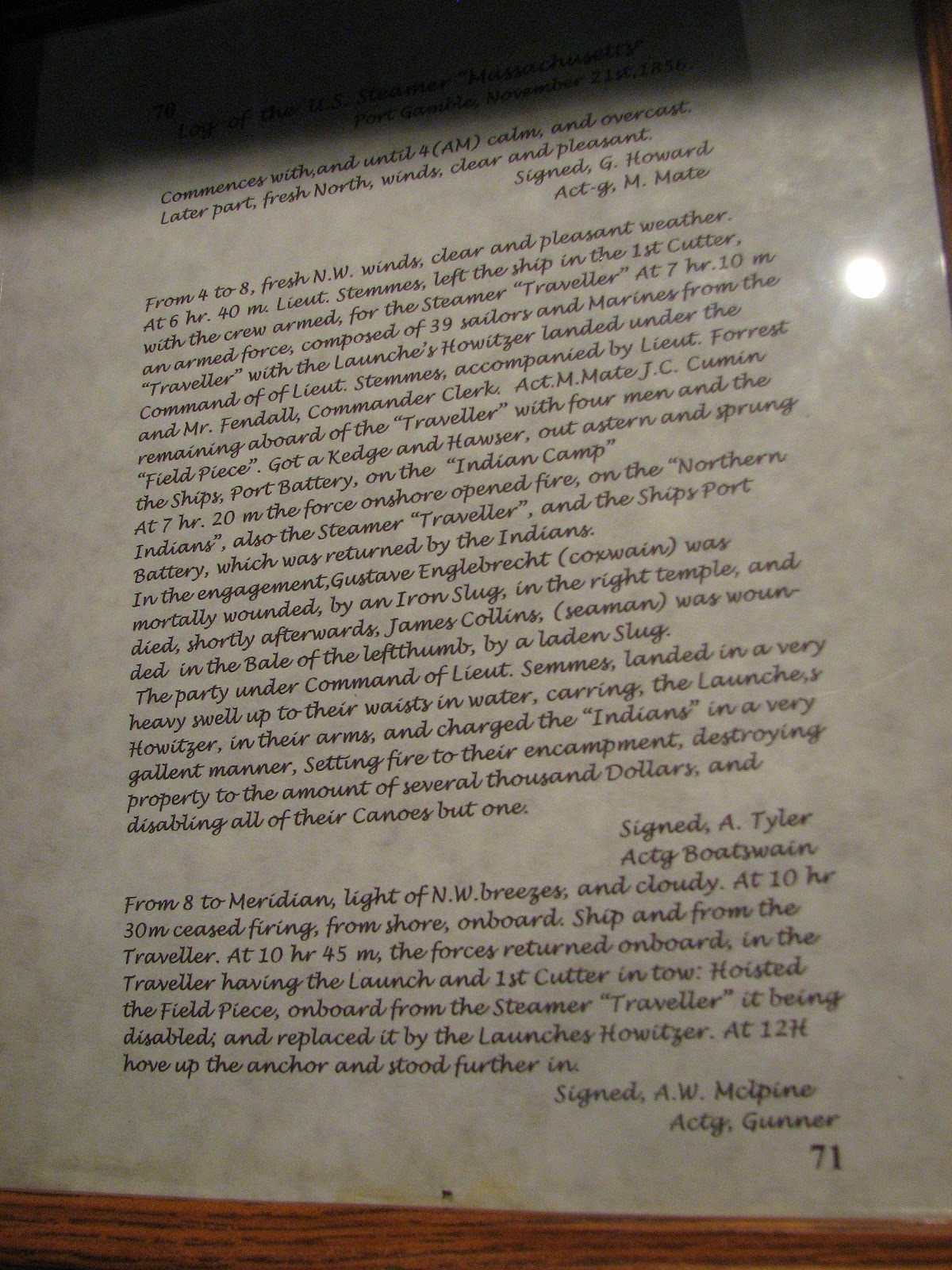
 LOG OF THE U.S. STEAMER "MASSACHUSETTS" - PORT GAMBLE - NOVEMBER 21, 1856

Commences with and until 4 (AM) calm, and overcast.  Later part, fresh North winds, clear and pleasant.  Signed G. Howard. Act-g. M. Mate

From 4 to 8, fresh N.W. winds, clear and pleasant weather.  At 6 hr. 40 m. Lieut. Stemmes, left the ship in the 1st Cutter, with the crew armed, for the Steamer "Traveller".  At 7 hr 10 m an armed force, composed of 39 sailrs and Marines from the "Traveller" with the Launche's Howitzer landed under the command of Lieut. Stemmer, accompanied by Lieut. Forrest and Mr. Fendall, Commander Clerk.   Act. M. Mate J.C. Cumin remaining aboard of the "Traveller" with four men and the "Field Piece".  Got a Kedge and Hawser, out astern and sprung the ships, Port Vattery, on the "Indian Camp".

At 7 hr 20 m the force onshore opened fire on the "Northern Indians", also the Steamer "Traveller", and the Ships Port Battery, which was returned by the Indians.  

In the engagement, Gustave Englebrecht (coxwain) was mortally wounded, by an Iron Slug, in the right temple, and died shortly afterwards.  James Collins, (seaman) was wounded in the Vale of the leftthumb, by a laden slug. 

The party under Command of Lieut. Semmes, landed in a very heavy swell up to their waists in water, carrying the Launches Howitzer, in their arms, and charged the "Indians" in a very gallent manner.  Setting fire to their encampment destroying propery to the amount of several thousand dollars and disabling all of their canoes but one.   Signed A. Tyler - Actg Boatswain

From 8 to Meridian, light of the N.W. breezes, and cloudy.  At 10 hr 30 m ceased firing, from shore, onboard ship and from the Traveller.  At 10 hr 45 m the forces returned onboard, in the Traveller having the Launch and 1st Cutter in tow; Hoisted the Field Piece, onboard from the Steamer "Traveller" it being disabled and replaced it by the Launches Howitzer.  At 12 H hove up the anchor and stood further in.  Signed A. W. McIpine - Actg Gunner

These items were on display.


 38 STAR AMERICAN FLAG - While the exact origin of this particular flag is uncertain, it appears this version of Old Glory flew over the mills at Port Gamble and Port Ludlow between the years of 1876 and 1890.  It was hand sewn by "Granny" Craig, wife of a Port Gamble sawmill foreman, and later given to James Kiefer, and early attorney for the Puget mills.  

This flag was graciously donated by Mr. Edna Keifer Fergunson, daughter of James Kiefer. 

SAW FILLING ROOM - Playing a key role in saw milling are the master craftsmen known as saw filers.  This represents a saw filing room at Port Gamble in the early 1900s.  Displayed is a small anvil, used for tensioning and straightening circular saws, a circular saw grinder, and a band saw grinder which is set up for, and will be in actual use when needed. 

SAN FRANCISCO LUMBER SALES OFFICE - On December 3, 1849, A.J. Pope, Fredrick Talbot, Captain J. P. Keller and Lucius Sanborn started business under the original name of Pope & Talbot.  Fundamental to the commerce of San Francisco in the 1850's were two things best known to Pope & Talbot - ships and lumber.  While Talbot took care of the shipping part of the business, Pope handled all sales and merchandising from this office at the corner of Pine and Battery Streets in downtown San Fransisco.  Pope was so successful at selling lumber that he kept his seafaring partner Talbot almost continuously at sea bringing lumber from the Puget Sound to their San Francisco sales yard.

MYSTERIES OF WOOD ...  The unusual collection of "modern" fossils aptly demonstrates Nature's adaptability as well as the havoc it occasionally brings to sawmills.  Glass insulators, iron spikes, barbed wire - these and other elements of man over the years have found their way into the growth of trees.  In many cases, they remain undiscovered until met by the high-speed sawmill blade.  The shattered, twisted result is vivid testimony to the violence of the meeting. 

In this picture you can see the window on the far wall - there will be a picture of that later on....


A drawing of Port Gamble back in the day ...


STREETS OF SAN FRANCISCO ...  From A. J. Pope's office this is how San Francisco appeared to Pope & Talbot in the early 1850's.  San Francisco was building to serve the miner's search for gold in the nearby Sierras.  With the boom, came the derelicts and criminals.  Talbot described the area immediately across the block as a den of robbers and desperado   It was a "Lovely and desolate spot even in the daytime, and at night a place to be avoided." 

The Puget Hotel


Some photos .....

MRS. J.P. KELLER...  She and her daughter were the first white women to visit Port Gamble site.  Later she sent out Maple tree slips from E. Machias, Maine that became huge trees that shade Port Gamble streets today.  

CAPTAIN J.P. KELLER... Original partner in Puget Mill Company.  Brought first mill machinery from Boston, Mass. in schooner "L. P. Foster."  First manager of Pope & Talbot Mill. 


Kaedyn, Nathan, Noah and Ivy ... unhappily posing for a pic.

Okay - from now on I'm not going to write it out if it's easy to read :)


The Indian House display is below ...


This was a display about planting trees and the Forest Research Center...

Photo timeline going back in history ....


Maps


Documents


The Library


Noah taking a seat in the "library" ...


HAND CARTS ... 1800s - Early 1900s ...  This hand cart was used by the dock repairman (called 'wharf rats') to haul tools, timber, nails, etc. for repairing the mill dock.  They also had larger carts which were pulled by horses until the arrival of the electric jitney and later the gas jitney.